
You’re in.
Turn the page for Chapter Two.
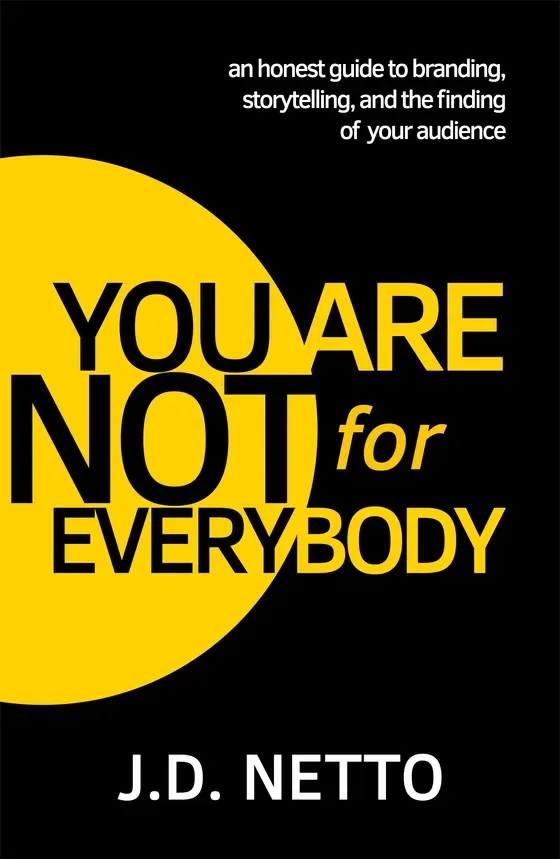
Free sample · Three chapters
“You can’t build a brand without exploring who you are.”From Chapter One
Read here in your browser, or download for Kindle, Kobo, Apple Books or PDF. . You’ll join J.D.’s readers’ list; unsubscribe anytime.
Praise for J.D. Netto
“Netto’s prose is urgent and bold.”

“Heartfelt and authentically grounded; a must-read.”
Chapter One
You can’t build a brand without exploring who you are. And like the human mind, a brand evolves with time. The “you” of ten years ago is vastly different from the “you” of today. You may have the same values, relationships, and possess facets that have largely remained the same, but a lot in you has changed.
A brand consists of pillars inspired by the mind of its maker. The moment an individual decides to build their brand, they make a conscious decision to look inward. To make it simple, your brand is rooted in your purpose, no matter the industry or talent.
Someone who’s secure in their identity has already built a strong foundation for a brand. Knowing what you like, stand for, and aim to do will inspire you to not only embrace your ideas, but build a platform to share them.
Some reality TV celebrities are fully aware of the influence that comes with a strong identity (and the process of discovering that identity). While some claim they don’t deserve their spotlight or influence due to their lack of talent, they are holding people’s attention by simply being who they are—no matter how questionable their decisions may be.
These shows keep gripping audiences because their narratives are crafted around the good, the bad, and the ugly. As you might’ve seen before, these shows and their protagonists aren’t afraid to embrace their truth (or their lies, however you choose to see it).
Let’s look at this from a storytelling angle. Every story starts by introducing the main character, their world, and the conflict. In most stories, it is through the conflict and discovery of self that they find love.
Experiencing a brand for the first time is a lot like going on a first date. Yes, we’re going there. Do let me know if you need time to get back in line for some cake or a pastry. No? Gotcha!
Imagine you match with someone on an app. After exchanging numbers, you text for a while and agree to meet in person. There was a spark—something that told you seeing them would be worth your time. You’re on your way to the date and keep thinking about that funny thing they said and the picture that made you blush, when you see them. And they see you. You’re a bit guarded at first. Do they look like their photos? Are they as eloquent in person as in their texts? Will the spark stay lit?
You sit at the table, and the conversation begins. You’re analyzing their behavior, beliefs, and mannerisms. There’s a rush of emotion running through you. If the date goes well, more texts and dates will hopefully culminate in a relationship. If not, then that’s it. The boat sank before it sailed.
First dates are about impressions. There’s no denying it. Both parties are calculating every move to see if the other will be worth the effort. But more than observing outward traits, we are longing for the spark—that intangible feeling.
That’s where dating and branding share a lot in common. Your potential audience will constantly go on first dates with your brand, and it must be as good in person as it is on paper. Every detail matters. It’s about how you look at the other person and your tone of voice. It’s the topic of conversation, the way you draw them in, and the way they engage with you. It’s the little details and mannerisms that keep you both excited.
Look at James Cameron’s hit movie Titanic. I’m going to go ahead and assume that if you’re holding this book, you’re old enough to have seen this ’97 classic. But I understand we have an entire generation who hasn’t watched it, so please, do so if you haven’t become a fan like me. You won’t regret it.
Put aside the historical event and step past the tragedy of it all, what you get is the story of a young woman who has one unforgettable first date on the poop deck of the grandest ship in the world with a random man from steerage. In the rush of emotions, she found herself wanting more. Jack pays attention to what Rose needs. She has money but is trapped by societal standards. She isn’t what others expect and is fighting to break free. She craves uncharted waters (pun intended). And he can give her that, even without a dime in his pocket. They each have what the other needs. Jack’s brand is adventure, while Rose’s is freedom. Say what you want about the speed in which they fall in love, but the story works.
The point is that we’re all in the business of feeling. It’s the human heart that creates connection, not a mere product or entity. You can build a brand around a product, but you can also have a personal brand that will exist beyond anything you do or don’t release.
In the end, whatever path you choose, people will seek out the spark over anything else. It’s all about how you make them feel.
Why do you think companies invest so much in events that immerse people in their brand, therefore discovering their products? Look at expos. You head to a convention center to network and discover new brands by means of immediate experiences.
Movie premieres, pre-screenings, red carpet events. These are all first impressions that inspire you to feel a certain way toward the brand and product.
We are all in the business of feeling.
Coffee shops do not only sell coffee. They sell a creative environment where you can enjoy good food and get some work done. Disney does not sell theme parks. They sell dreams and the chance to be a child again. Luxury brands sell status—they are a symbol you work hard to be who you are. In the same way feelings guide us, the intangible part of your brand will steer your audience closer or farther from you. There’s no way around it.
The simple truth is you cannot build a brand without a foundation. And that foundation needs to be rooted in the core of who you are. The colors of your logo, the design of your website, every visual must convey the emotions you expect the audience to feel when consuming your product or service.
Let’s do an exercise together. Feel free to use the space below, grab a notebook, or open the notes app on your phone. Write down your passions. And I do mean your passions.
Pay attention to how you feel when something comes to mind. Do you get butterflies? Jitters? Does it make you smile? Your passions are a compass. We can only thrive and grow when we are passionate. And in case you’re wondering, But J.D., how do I identify my passions? Here’s my own little trick. Much like when falling in love, passion for your purpose and goals can be identified by how much real estate it takes up in your mind. The word ‘passion’ has many meanings, but let’s stick to the one I found on Merriam-Webster: a strong liking or desire for or devotion to some activity, object, or concept.
Alright, back to the exercise. Next to each passion, write down a skill you possess that can turn it into reality. Here’s some examples: I love to cook and can make a mean steak. I love to travel and can edit a 30-second video about my experience in an hour. I love public speaking and am very eloquent in front of the mirror. _____________________________________________________ ____________________________________________________ _____________________________________________________ _____________________________________________________ _____________________________________________________ ____________________________________________________ _____________________________________________________ _____________________________________________________ _____________________________________________________ _____________________________________________________ ____________________________________________________ _____________________________________________________ _____________________________________________________ _____________________________________________________ _____________________________________________________ _____________________________________________________ _____________________________________________________ _____________________________________________________ _____________________________________________________
It feels good to be honest with ourselves about what we can do. We’re often honest about our mistakes, or the lack thereof. Read what you wrote and pay close attention once again to how you feel.
The first time I expressed my feelings on paper was at the age of four. I don’t remember drawing the piece (my parents saved it), but I do remember why I loved the story. The crucifixion of Christ fascinated me. And not for the reasons you might think. The spectacle and drama drew me in. My aunt had an illustrated Bible in her house I would flip through whenever I visited. Despite the many stories, it was the picture of the crucified man between two thieves that intrigued me.
Over the years, my fascination with religion led me to discover tales just as grand—big epics such as Michael Crichton’s Jurassic Park and J.R.R. Tolkien’s Middle-earth. I loved how stories, visuals, music—art—had the power to engross the mind and make you forget your surroundings. I started perusing through magazines on science, paleontology, and history. Until one day, I found a fashion magazine at a friend’s house. Curious, I picked it up and boom. There was a spread of two men sharing a very passionate kiss. I don’t remember what cologne it was advertising, but God, do I remember how the ad made me feel. I think that was the day I knew I was gay.
But more than an ad helping me affirm my sexuality, I was taken by the notion that a cologne was being sold through a gay kiss. This was the mid-nineties in a small town of Brazil. I can’t say my surroundings were progressive back then, but even at a young age, I knew I’d remember the ad for years to come. Whether through inspiration or shock, the campaign had done its job.
I noticed the power of narrative not only in books, movies, and music, but in the pieces marketing them: posters, videos, album covers, etc.
During my teenage years, I attended Joseph P. Keefe Technical High School in Framingham, MA. Freshman year was about exploring all twenty-one shops. I failed miserably at being a carpenter, a hairdresser, and a cook, but then visual arts came along.
I excelled in structuring a comic book story with visuals. I created a board game, crafted an entire campaign for a bottle of milk, and designed my first business card. I realized that my passions aligned with my skills.
Years later, I learned that narrative is an essential part of selling a product (art-related or not). I discovered my love for stories and honed my craft. I noticed that, more than pretty visuals, my clients loved when I explained the message behind them. Suddenly, there was a lot more value to what I created.
Writing books. Graphic design. Brand strategy. J.D. Netto Creative. All these endeavors are a culmination of my passion for storytelling.
Go back to our exercise. Read it one more time. So I ask again. Who are you? What is life reflecting back at you? Don’t fall in love with the idea of being something. Fall in love with the journey that will get you there. Those experiences will be the heartbeat of your brand.
Join J.D.’s readers’ list and keep reading right here. We’ll email the chapters too, so you never lose your place.
No spam. Unsubscribe anytime.
Turn the page for Chapter Two.
Chapter Two
No, talent isn’t enough to build an audience. There’s more to cultivating followers than being good at something. Many people are overshadowed by their talent because they think it immediately qualifies them for relevance. Well, sorry to say, but it doesn’t.
You’re scrolling through social media and stumble upon a video of a singer. They’re singing an original, and you think their voice is pretty, so you click on their account. That’s when you see them covering one of your favorite songs. The one someone you loved used to sing when you were young. It’s in that moment you are converted from a mere listener to a fan. You click the “follow” button.
Now you want to know this artist’s backstory. You research their upbringing, struggles, victories, favorite brands. You’re looking for the rags-to-riches story we love from our favorite shows. You want to know where they stand on certain issues, their opinions, likes, and dislikes.
Talent is a bridge people can walk on or walk off. Don’t believe me? Think about artists you enjoyed in your teenage years. Some you still love and occasionally listen to. Others make you cringe. Their talent didn’t poof into thin air. Your interest in them did because they stopped making you feel a certain way.
Feel what, J.D.? Something. Curiosity. Anguish. Fear. Inspiration. What happens after you watch a documentary inspired by an artist? You go back to their music, books, movies, products, etc. You reminisce, and once again, that artist is on your mind not because of talent, but because of feeling.
Curiosity becomes loyalty when talented people make you feel. Artists are, after all, the essential workers of our hearts. We need music to get through breakups, books for an escape, and so on.
Entrepreneurs are artists. They inspire with their boldness to tread new ground. It’s an intense job to not only run a business, but find new ways to stay relevant.
But J.D., will I spend my entire life aiming for relevance? Does it ever stop?
Well, think of it this way. You may not talk to your best friend every day, but when you do, it’s as if no time at all has passed. The same happens with an audience you’ve poured your heart and soul into. Even if you disappear for a while, they’ll be willing to rediscover the new you.
This is different from turning away from someone you once followed, listened to, read, or bought from. Here’s an example, Evanescence is my favorite band. Their album Fallen had such a tight grip on me, I started writing poetry because of it.
It took the band three years to release a new record. During that time, I became loyal to new rock bands, products, and movies. But the moment I saw a banner on their website announcing The Open Door, I bought the new album immediately.
Audiences follow because they feel. You root for your favorite sports team out of a sense of pride. You follow someone online because their content sparks feelings. You aren’t just a fan of the talent. Talent led you to a community where you belong.
As a child, I was never a big fan of shows or cartoons without structure. I’d watch them if they were on, but I craved a continuous storyline. That was when I became a fan of Japanese animation. Yes, they were dramatic, but their bold narratives and character expressions drew me in. My absolute favorite was Saint Seiya, the story of a young orphan chosen to be one of the knights of Athena.
I felt out of place during most of my childhood. In the early 90s, people on my side of town didn’t expect little boys to be artists. Never mind gay. So finding a show where a boy who doesn’t belong becomes a knight had me hooked.
I was the target audience for the show because I longed for an escape from the world I lived in. I wanted a sense of adventure and awe. To this day, if I am somewhere and spot anything relating to Saint Seiya, I will peruse the shelves and often make a purchase. I am not just a consumer. I am still an active audience member because of the emotional connection I have with the product.
Chapter Three
This is where the secret lies. For you to have a brand and an audience, it’s imperative you understand narrative. No, you don’t need to be a writer to wield this weapon. You just need to be both aware of the now and one step ahead of it.
Stories are essential for society. We crave them. We love sharing and being a part of them. And we love the communities created by them.
Stories turn us from consumers into audience members. An audience does not exist without a narrative. Whether you’re watching your friend’s videos online, reading a book, turning on a movie, or sharing some salacious news with a friend, it is narrative that inspires us to take action.
Narrative is a structured story. It introduces an audience to the main players on the board, takes them on an emotional quest, and wraps up the main events with a pretty bow.
Think of your favorite show. The visuals may be stunning, the acting superb, but if the narrative is predictable, the movie goes from epic to, well, corny. I am not saying predictability is bad. I’m saying it needs to be done with intent.
A narrative makes promises. We want certain characters to win and some to suffer a great demise. But there’s one common thread connecting all sorts of narratives. You may like dragons, orcs, and elves, but it is the human experiences that keep us engrossed. It’s the tragic death of someone we rooted for and the vengeance taken against the queen we loathe so much. It’s the villain winning every battle only to lose the big war.
What happens when your favorite show nears the end? Maybe for the finale, you call your friends and get the snacks. You’re ready to feel something. As the episode unravels, you are in awe at how terrible your favorite character’s fate is. The credits roll, and lo and behold, the ending didn’t live up to your expectations. You talk about it with your friends, on socials, and on forums.
Narrative is what keeps you hooked until the end.
If narrative didn’t matter in branding, we’d simply have ad campaigns that said the following:
I am the best shampoo you will ever use.
Toothpaste. Because cavities are a bitch.
Unprotected sex might give you diseases. Use condoms.
I think you get the idea.
Instead, we have writers (hello!) creating an emotional connection between audiences, products, and brands.
Imagine this scenario, you saw an ad for a certain article of clothing. The pictures looked stunning, the video was well edited, and the copy promised you’d feel gorgeous while wearing it. When the box is finally dropped off on your porch, you open it and find the material is of poor quality. You put it on and realize the cut is unflattering. It’s nothing like the picture. You look for the return information, only to see the sentence that sends you to customer hell and back: credit only.
Narrative, narrative, narrative. The narrative made you a promise. The narrative led you to believe, and the narrative failed to deliver. Whether for good or ill, you felt something and took action.
Let me give another example you encountered right here in this coffee shop. When you bought your drink at the counter, did you see those three little buttons on the machine with tip percentages? Did you notice that beneath each number was a very specific word: 15% average, 20% good, 25% excellent.
What did you feel as you read each word? Did you immediately give a little something so you didn’t come across a certain way? Did you brush it off because, hey, I simply bought some coffee, and I am not obligated to tip someone because they tapped on a screen. Maybe you were compelled to give twenty-five percent because you can. You don’t want to be rude. You will forget about the money five minutes later.
See the impact of those three little words? Each one summarized how you might have felt about the service (all positive). This isn’t about you being a good or bad tipper. This isn’t a discussion of whether or not you should tip. This is about the narrative on that little screen. Suddenly, it’s up to you and your conscience to either agree or disagree with the narrative of a positive experience.
I’m sure you’ve seen those sad commercials about puppies in need of adoption. Trust me, if I could, I’d buy a farm and adopt as many as possible. But I invite you to look at the structure of the commercial.
The music immediately sets the tone for what’s to come. Paired with the images of those huge eyes and longing stares is a voiceover that pulls you in. It hits you so hard, you throw out any thoughts of the production value and simply feel the emotions. The narrative has engrossed you to the point that you think of those puppies every time you hear that song.
This happens in every facet of culture: media, shows, books, technology, politics, and more. A perfect example of the power of narrative is religion, and how it grows through stories and testimonies. These narratives are crafted to stir behavior. Do this for a reward. Don’t do that, and you’ll avoid damnation.
Your favorite TV series creates a cult following because the characters are so three-dimensional, you keep thinking about them after you turn off your device. You talk to your friends about them and dissect every word and action.
Book hangovers are a thing (and I hope this book gives you one) because you are so immersed in the story, you lose track of the time and page count. You simply care about your favorite characters getting the rewards they deserve. Narrative connects you. Narrative drives you, inspires you, and disappoints you.
Apply it to tech. The latest device is coming out, and the entire marketing campaign promised an immersive experience. You want to be surprised as you discover its new features. You want a certain amount of safe unpredictability. But you do want one thing to be predictable—your satisfaction.
In politics, you follow your candidate’s campaign. You watch their ads and news outlet appearances, donate, listen to their speeches, and hold on to the promises they make. You vote for who connects with you and your values. It is narrative that differentiates political parties from one another and inspires voters to act.
Narrative is a brand’s heartbeat. It’s the stories we write and the characters we create that foster community. Let’s bring it back to you. How do you apply the concept of narrative to your brand?
Let me share how I structure my novels to connect with readers. I like to write them in four acts. Each act helps me pace the story, understand the motives of every character, and reward the readers who choose to pick up my books.
Act One: The first act serves as setup for the story and world. This is where I introduce readers to the character’s motives, struggles, and strengths. This usually consists of an ordinary situation that possess a hint of intrigue. But the ordinary can only last for so long. It must end with an inciting incident—a turning point that will change the character’s life forever.
Act Two: This is where the conflict begins—the moment the character’s world is shaken up and they must make decisions (clever or foolish). This act must take the story to a midpoint so epic, the character will have no choice but to embrace the struggle and aim for victory.
Act Three: This act exists because the character won’t accomplish what they need to do at first. They will fail more than once. This is the moment when the reader can’t see how the story will end on a good note. The heroes are tired, the antagonists are winning, and there seems to be no way out.
Act Four: This is the crowning jewel—the moment the reader has been waiting for. The heroes have seen the light at the end of the tunnel and discovered the loophole that will lead them to victory. I reward my readers with the element of surprise. This is the act where I connect all the dots and create an air of mystery around the things I want to keep secret. But in the end, I deliver what I promised the reader.
Allow me to break this down in a way you can apply to your brand:
Act One: Your setup should include an ordinary fact about your audience—something they want (or will want) to change. This is your chance to connect with them where they are. If there’s already demand for your product, then this is where your inciting incident will inform them of such demand. If not, this is your chance to create an inciting incident that will produce the demand.
Act Two: Your audience will be thinking about the events of the first act. How will this product benefit me? How will this person help me? What am I getting out of it? While your audience ruminates, you act. Stay connected to your audience, but offer them pieces of information that will spur them into action.
Act Three: This act belongs to your audience. If you were clever with your first two acts, your audience will see how they’ve been failing and will continue to fail if they do not acquire your product. Example: You feel left out if you’re not listening to the music everyone’s been talking about. Embracing that singer means you are now part of the crew.
Act Four: Your audience is the hero and they have won. What did they win? A crown. And what is the crown? Your product. Now your job is to deliver. You promised a good product? Then it better be good. Because otherwise, this is where a heroic audience turns villainous.
I am happy you’ve gotten this far. Not so happy that from now on, whenever you watch a movie or read a book, you’ll be able pick up on and critique this technique.
“Narrative is a brand’s heartbeat.”
Pick your store on the next screen.